
EU customs changes on 1 November 2026: is your product data ready?
This change concerns the product references sent with an EU order. Check which references your shop and suppliers hold, and whether they reach the company completing your customs declaration.
Does this affect my orders?
It concerns qualifying online sales where the goods are outside the EU when sold, then sent to an EU customer. Under current legislation, it is not limited to IOSS or parcels worth €150 or less.
Ordinary business-to-business imports and orders fulfilled from stock already released into free circulation in the EU follow a different process.
Updates to this article
Rechecked Regulation 2026/1022, its corrected text and Commission guidance. Added Dutch Customs’ 2 October scope clarification: current legislation also includes consignments above €150; a narrower scope is intended but not yet official. The 1 November start date and original publication date remain unchanged.
Rechecked the November requirement, added a preparation-refresher link and clarified conditional special cases and use of an S-PID as an NS-PID. Original publication date retained.
Added worked examples for booksellers using ISBN/EAN references, clothing variants, products without a barcode, personalised clothing and second-hand books. Clarified supplier adoption, separate reporting fields and when Y081 is appropriate. Original publication date retained.
Special cases to check with your declarant
The Commission allows the manufacturer to use an existing S-PID as its NS-PID too. It also provides administrative tolerances for specified product codes, including certain agricultural, handmade and antique goods, plus separate healthcare instructions. These are conditional—not a general exemption for handmade or second-hand products. Check section 3.5.7 of the official guidance before using a tolerance.
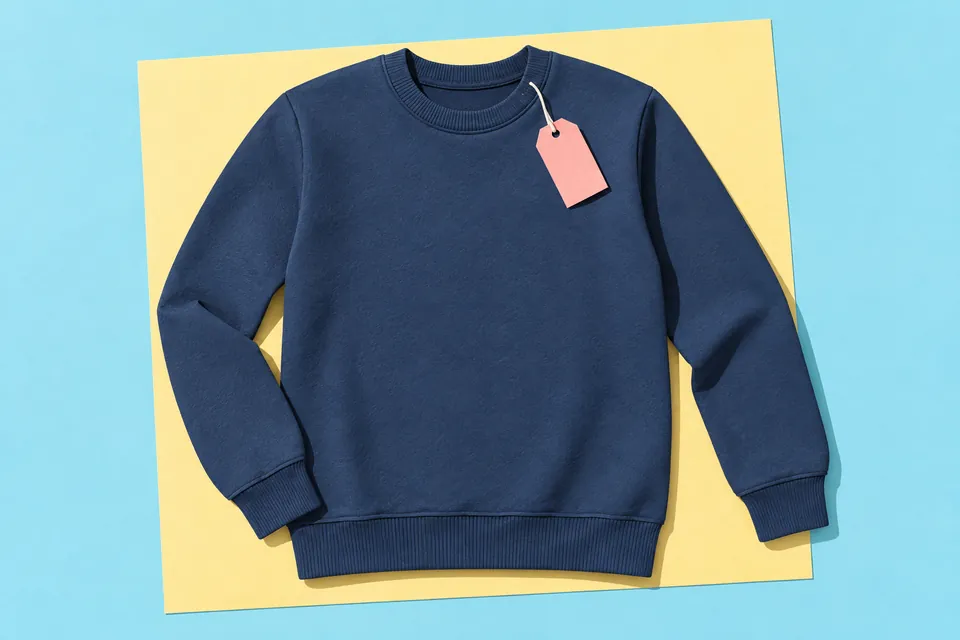
- Your shop’s reference · M-PID
- SW-NAVY-M
- Your supplier’s reference · NS-PID
- F4482-NV-M
- Standardised identifier · S-PID
- The genuine EAN or GTIN, if one exists.
If no standardised identifier exists, the declarant uses Y081. The references shown here are illustrative, not codes to copy into your own orders.
The simple explanation
From 1 November 2026, Product Identifiers—PIDs—must be included in customs data for qualifying distance sales of imported goods. A tracking number identifies the parcel; a Product Identifier identifies the item inside it.
For each item, the customs data must include a merchant identifier and a non-standardised manufacturer identifier. A standardised manufacturer identifier must also be supplied where one exists; otherwise the declarant uses the appropriate absence code.
The three identifiers
1. Merchant Product Identifier (M-PID) — C127
This is the product reference assigned by the online seller, website, marketplace or platform. A SKU may be suitable only where it identifies the exact product or variant sold. A blue medium T-shirt, for example, should not share an identifier with a red or differently sized version. This identifier is mandatory.
2. Non-standardised Manufacturer Product Identifier (NS-PID) — C128
This is an internal product reference assigned by the manufacturer, producer or product supplier. It does not need to follow an international numbering standard. Where none exists, the Commission guidance says the manufacturer, producer or supplier should assign one; no set format is prescribed, but it should remain consistent and identify the correct product. This identifier is mandatory.
3. Standardised Manufacturer Product Identifier (S-PID) — C129
This is an internationally recognised identifier, such as an EAN, GTIN or ISBN. It must be provided where one already exists. A business does not need to purchase or invent one solely for this customs requirement; where no S-PID exists, the customs declarant uses code Y081.
Product identifier examples for retailers
Illustrative catalogue examples—not real product references to copy. Check your own records and test the fields with your declarant.
Booksellers: can an ISBN or EAN fill both fields?
Yes, where the publisher or relevant manufacturer, producer or product supplier adopts the standardised identifier as its NS-PID too. The same value can then be reported under both C128 and C129; your merchant reference under C127 is still needed.
- C127: your shop or marketplace’s reference for the book offered.
- C128: the book’s genuine ISBN or EAN, where adopted for this role by the responsible supplier.
- C129: the genuine standardised identifier. Do not use Y081 when an ISBN or EAN exists.
Ask the publisher or supplier to confirm its approach, then ask your shipping provider how to populate both fields. See Commission guidance, section 3.5.4, pages 27–28 ↗.
Clothing: the colour and size matter
For an illustrative navy medium sweatshirt: C127 could be SW-NAVY-M, C128 F4482-NV-M, and C129 its genuine barcode identifier. A red or large version needs the references for that variant—not a general “sweatshirts” code.
A product without a barcode
Imagine a small maker’s pencil case with no standardised identifier: the shop uses CASE-GREEN and the maker uses PC07-G. These illustrate C127 and C128. The declarant uses Y081 only if no S-PID exists—not merely because you have not obtained it.
A personalised T-shirt
For a T-shirt printed with a customer’s name, use the underlying textile’s product identifier as the guidance directs. An order number is not a substitute.
A second-hand book
Use the original product’s identifiers; being second-hand is not itself an exemption. If the original reference is unknown, investigate with your supplier and declarant rather than inventing one.
Commission guidance on personalised and second-hand goods, section 3.5.7, page 32 ↗.
Who it affects
The requirement applies where goods are sold online while still outside the EU and are then sent to the EU customer. This includes sales through a retailer’s own website, online marketplaces, social-commerce platforms and other qualifying distance-selling channels.
It is not restricted to IOSS shipments or only to parcels valued at €150 or less. The legal data requirements cover qualifying distance sales declared through the relevant H1, H6 and H7 customs datasets. Ordinary B2B imports are not the target of this specific rule, and orders fulfilled from goods already released into free circulation in the EU follow a different process.
Who provides the information?
- The seller, marketplace or platform assigns and supplies the M-PID.
- The manufacturer, producer or supplier supplies the NS-PID and any S-PID.
- The customs declarant—such as a carrier, postal operator or customs agent—transmits the identifiers to customs.
A logistics provider cannot reliably create catalogue and supply-chain identifiers on the seller’s behalf. The data must reach it in the format its systems require.
What e-commerce businesses should do now
- Review the complete catalogue. Include every size, colour, model and variation sold into the EU.
- Create the required fields. Store M-PID, NS-PID, any existing S-PID and confirmation where no S-PID exists.
- Speak to manufacturers and suppliers. Request both their internal reference and any recognised EAN, GTIN, ISBN or other standardised identifier.
- Check the full technology chain. Make sure the data survives the journey through the website or marketplace, order and warehouse systems, shipping platform, carrier interface and customs declaration.
- Ask the logistics provider. Confirm field names, accepted formats, test dates, item-level support and how C127, C128, C129 and Y081 will be declared.
- Test real orders. Follow several products, countries and sales channels from the catalogue to the carrier. Voluntary submission has been available since 1 July 2026.
- Update the new-product process. Do not offer a new product to EU customers until its required identifiers are recorded.
PIDs do not replace existing customs information
Businesses still need a clear product description, the correct commodity or HS code, country of origin, product value, quantity, weight and relevant tax information. Product Identifiers support that information; they do not replace it.
What happens from 1 November?
Mandatory application starts on 1 November 2026. If required data is missing or incorrect, the declarant may be unable to submit a compliant declaration, creating a risk of rejection, customs queries or delivery delays.