
How to write an accurate customs description
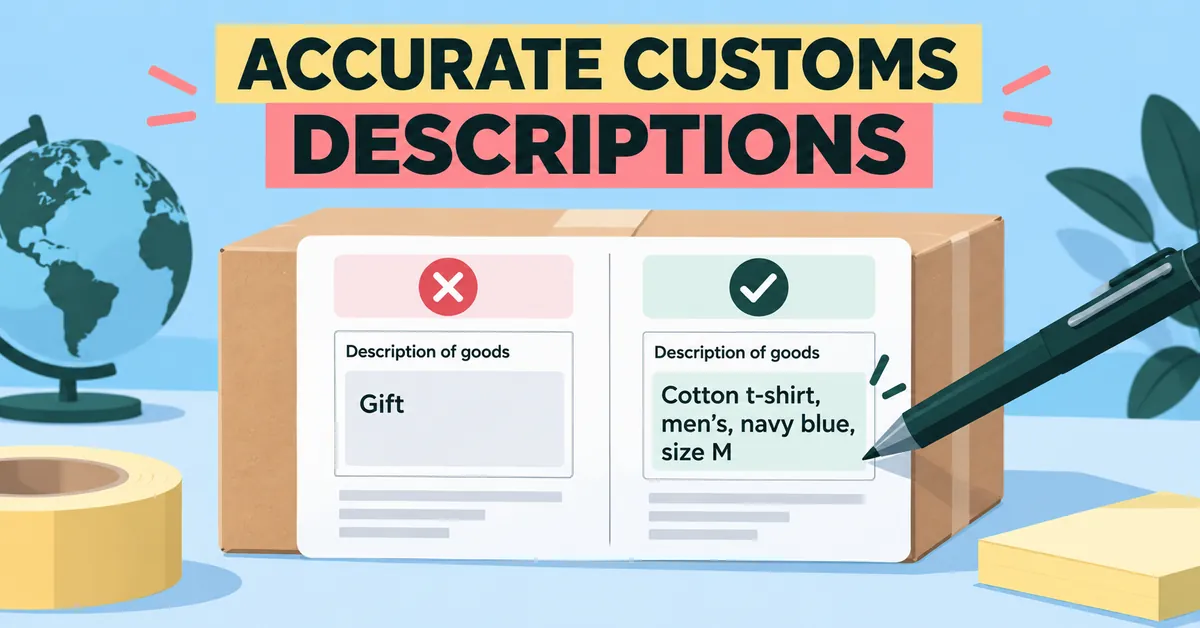
A good customs description tells a person what is inside the parcel. “Goods”, “parts” or “gift” does not.
Write the description in plain language and make it precise enough for customs to identify the product. Start with what the item is, then add the material, purpose or other detail needed to distinguish it.
Try it with one product
Turn the facts you know into a plain-language draft. This helper only joins what you enter—it doesn’t research the product or fill in missing facts.
Works in your browser. Your entries stay on your device and aren’t saved by this website. Don’t enter customer or order details.
Use one product at a time. If you don’t know a fact, check with your supplier—don’t guess. Read the guidance below ↓
Why the description matters
The description travels with the shipment data and helps customs authorities and carriers identify the goods, assess risk and check whether the classification and other declaration details make sense. Official UK guidance says it must be precise enough for customs services to identify the goods.
Vague wording can lead to questions, inspections, corrected declarations or delays. A clear description does not guarantee clearance, but it gives the declarant and customs a better starting point.
A practical way to build the description
There is no single wording formula for every product. For an ordinary consumer item, consider whether the description answers these questions:
- What is it? Name the actual product—not the reason it is being sent.
- What is it made from? Include the main material or composition where it helps identify or classify the item.
- What is it used for? Add the function when the product name alone could mean several things.
- What distinguishes it? Include gender, product type, model or another relevant characteristic where needed.
Only include details that are accurate. Do not guess a material, function or model simply to make the wording longer.
Customs description examples: from vague to useful
| Avoid | A clearer description |
|---|---|
| Clothing | Men’s cotton T-shirt |
| Shoes | Women’s leather ankle boots |
| Parts | Stainless-steel bicycle brake lever |
| Electronics | Rechargeable Bluetooth speaker |
| Accessories | Silicone mobile-phone protective case |
| Sample | Cotton fabric samples for product testing |
| Gift | Children’s illustrated paperback book |
| Merchandise | Ceramic coffee mug |
These are illustrative examples. The right level of detail depends on the actual item and the destination’s data requirements.
Describe the goods—not the shipment reason
Words such as gift, sample, return and warranty replacement explain why an item is moving. They do not identify what it is.
Keep the product and shipment reason separate where the form allows it. For example:
Men’s cotton T-shirt — promotional sample supplied free of charge.
The description identifies the product; the additional wording explains the reason for export.
Use a separate line for different products
Do not hide a mixed order behind “assorted goods”. Give each different product its own invoice or declaration line where required, with the corresponding quantity, value, origin and commodity code.
Several identical items may be shown together on one line when the declaration rules and carrier system allow it. Products with materially different descriptions, classifications or origins should not be combined merely to shorten the invoice.
The description and commodity code do different jobs
A commodity or tariff code classifies the goods within a customs tariff. The plain-language description explains what the goods actually are. Supplying a code is not a reason to use an unhelpful description on the commercial invoice or carrier record.
Check that the description supports the code selected. “Plastic household storage box” provides a more useful sense-check than “product”, but the description alone does not prove that the classification is correct.
Keep the wording consistent
The product description should not tell a different story across your website, order record, commercial invoice, shipping label and carrier data. Small formatting differences are normal; material contradictions are not.
Save a verified customs description against each product and variant in your catalogue. This reduces manual typing and helps the same information reach every system involved in the shipment.
Before you send the parcel
- Replace general words such as “goods”, “parts”, “accessories” and “merchandise”.
- Name the actual product in plain English.
- Add material, function or product type where it helps identification.
- Separate different products rather than describing the whole parcel as one item.
- Check that description, commodity code, origin, value and quantity agree.
- Confirm whether the destination or carrier requires extra product details.
- Review controlled, restricted or regulated goods separately.
A clear description is one part of getting the parcel ready. Use the international shipping pre-dispatch checklist for the other checks, or read how postal and commercial customs clearance work to understand what happens next.
Official sources
- GOV.UK: data requirements for a Customs Goods Manifest
- European Commission: Union Customs Code guidance documents
- European Commission: acceptable and unacceptable descriptions of goods