
Customs clearance explained
Updated 16 September 2026: added the US Type 13 postal-entry test and October customs user-fee changes. The original publication date is unchanged.
Customs clearance means completing the formalities needed for goods to enter, leave or move under a customs procedure. For UK retailers shipping overseas, export and destination import checks are separate steps.
The delivery network moves the goods. The declaration tells customs about them. A customs check examines the information or the goods. Delivery terms decide who handles particular responsibilities and costs.
You do not need to memorise every code. You need to know what your provider means—and what you must supply.
This guide is for UK businesses. It starts with UK terminology, then explains common US and EU labels you may hear when shipping overseas. Great Britain and Northern Ireland do not always follow the same arrangements.
What does customs clearance actually mean?
Customs clearance means completing the formalities required for goods to enter, leave or move under a customs procedure. That can involve a declaration, supporting documents, any applicable duties and taxes, and checks by customs or other authorities.
For a UK retailer sending an order abroad, there can be export formalities on departure and import formalities at the destination. Completing one does not automatically complete the other.
“Released by customs” means the goods may proceed under the relevant procedure. It does not necessarily mean they have reached the customer, that no further records are needed, or that customs has approved every aspect of the product.
Postal and commercial clearance
Postal clearance
This describes customs arrangements for goods moving through the international postal network. You may recognise the CN22 or CN23 customs declaration used with postal items. The correct declaration and any extra electronic data or documents depend on the goods and the route.
A product sold by a business can travel by post. Postal does not mean a personal parcel, a gift, tax-free goods or freedom from product restrictions. A form attached to the parcel is not a guarantee of clearance overseas.
For the UK starting point, see HMRC’s guidance on sending post or a parcel abroad.
Courier or “commercial” clearance
When contrasted with postal clearance, providers often use “commercial clearance” for a non-postal courier or freight customs service. But it is not one universal declaration type: the phrase alone does not tell you which procedure will be used.
An online order for a private customer is still a commercial sale. Equally, a commercial sale can use postal delivery. Ask the provider: “Which customs declaration will you use for my goods in this country?”
Full and simplified declarations in the UK
A full declaration supplies the information required for the chosen customs procedure. In Great Britain, electronic import and export declarations are made through the Customs Declaration Service (CDS), usually using specialist software or a customs representative.
A simplified procedure can allow eligible goods to be released using a smaller initial set of information, with additional information supplied later. For example, the UK’s authorised simplified import procedure involves a simplified frontier declaration followed by supplementary declarations.
Simplified does not mean no paperwork or no tax. Conditions, authorisations and follow-up obligations apply. It is not automatically available just because a parcel has a low value. A business can use an appropriately authorised representative rather than operating the procedure itself.
Read HMRC’s simplified import declaration guidance for the requirements.
BIRDS: declaring eligible low-value imports together
BIRDS means Bulk Import Reduced Data Set. It allows an authorised declarant, or an agent acting for one, to declare eligible low-value parcels together using less data than a standard full import declaration.
This is a Great Britain import procedure. It is not the clearance used to export a parcel from the UK or a general procedure for imports into Northern Ireland.
It is separate from the simplified frontier declaration process above: BIRDS has its own authorisation and record-keeping rules, rather than that routine supplementary-declaration process.
The value limit is £135 or less for each qualifying consignment—not £135 for the whole bulk declaration. Other conditions matter too:
- The goods must qualify for import-duty relief and be subject to UK supply VAT rather than import VAT. BIRDS does not mean VAT-free.
- Excise goods, prohibited or restricted goods and goods requiring licences cannot use it.
- Goods moving under the Universal Postal Convention are excluded. HMRC’s term “postal packet” does not mean BIRDS is the same as international postal clearance.
A simple example: separate eligible £25 customer orders might be declared together. That does not allow one £250 customer consignment to qualify by splitting it into two packets.
Reduced declaration data does not remove the need for accurate parcel-level records. The operator must keep an electronic manifest identifying the individual goods and recipients.
If a provider offers “BIRDS clearance”, ask whether your goods qualify, who holds the authorisation, how VAT is handled and what information they need from you. It is a declaration arrangement, not a promise of no checks or guaranteed release.
Sources: HMRC’s BIRDS eligibility and authorisation guidance, introduction to BIRDS and BIRDS procedure 0020.
Route 1 and Route 2: UK customs checks
These are customs examination routes, not delivery services you choose when booking a parcel.
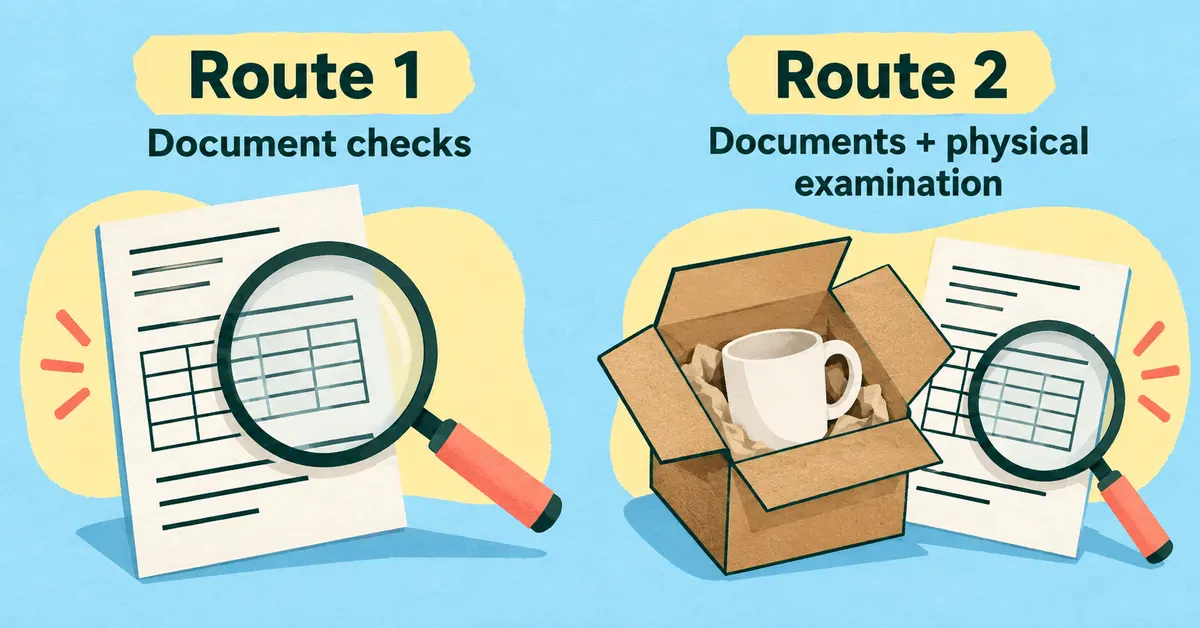
- Route 1: documentary checks. Customs requires supporting documentation to review the declaration. This could include the invoice and other evidence relevant to the goods.
- Route 2: physical examination as well as documents. Customs also needs access to examine the goods. The carrier or representative handles the practical arrangements.
HMRC’s Ecosystem of Trust report explains this distinction. Current CDS supporting-document guidance explains how requested documents are submitted.
If your shipment is selected, ask your representative what customs needs and provide accurate supporting information promptly. Do not assume every hold means a physical inspection, or that a check will finish within a guaranteed time.
Ask which country and system the speaker means. UK Route 1 is a documentary check. US entry Type 01 is a US import entry code. They are different things—even though people sometimes shorten the words when speaking.
Overseas codes: US Type 01, Type 11 and EU H7
These labels concern the destination’s import process. They are not names for getting goods out of the UK.
United States: formal and informal entry
- Type 01: a standard US consumption entry, commonly used for formal imports. “Consumption” generally means entering goods into US commerce, not that the product is food. Other formal entry codes also exist.
- Type 11: an informal entry for eligible goods. “Informal” is a customs category—not permission to leave out required information or avoid duty.
Value matters, but it is not the only factor. Product controls and other conditions can affect the required entry. Check the actual goods with the US importer or customs broker.
Type 86 is not a current alternative. This former low-value entry test is suspended. Do not rely on older articles presenting it as an available duty-free route.
Sources: US government entry-code table and CBP’s June 2026 non-postal entry rule (PDF).
US Type 13: a postal-entry test from 22 September 2026
Type 13 is a voluntary electronic informal-entry test for eligible international postal shipments worth $2,500 or less. It is not a general courier procedure or a return to duty-free shopping.
It can accommodate other US agencies’ required data and additional tariff information. Goods subject to anti-dumping or countervailing duties, or quotas, still require formal entry. CBP can also require formal entry for other shipments.
The authorised filer needs a customs bond and accurate product descriptions, origin, value, applicable ten-digit HTSUS codes and postal tracking data. Product-regulator requirements still apply.
For UK sellers: ask your postal provider whether it supports Type 13, whether your products qualify and what information it needs. Do not assume every postal service will offer it from the start.
Sources: CBP’s postal-entry test notice, published 24 June 2026. CBP’s 15 September system notice schedules production deployment for 22 September.
US customs user fees from 1 October 2026
CBP’s annual fee adjustment applies from 1 October 2026. Examples in the published schedule, in US dollars:
- $2.77 for an automated informal entry not prepared by CBP personnel.
- $7.61 for the dutiable-mail fee where applicable.
- $34.58 minimum and $670.86 maximum for the formal-entry merchandise processing fee; its percentage rate remains 0.3464%.
These are not charges to add together to every parcel. The applicable fee depends on the entry and any exemption. They are separate from tariffs and a provider’s own clearance or handling charges.
Ask your provider which government fees apply to your route and whether its quotation includes them. See CBP’s FY2027 fee schedule, published 31 July 2026.
European Union: H1 and H7
H7 is a reduced-data declaration for qualifying low-value distance-sale imports. It cannot be used for every low-value product or movement. H1 is a full-data declaration used for release into free circulation, among other applicable uses; it is not reserved only for expensive goods.
These are EU examples. Do not assume the same label has identical eligibility rules in Great Britain or Northern Ireland. See the EU regulation amending the declaration requirements and check the route with the declarant.
DDP, DAP and IOSS are not clearance types
DAP and DDP are delivery terms. Broadly, DAP puts import clearance and import charges with the buyer; DDP puts those responsibilities with the seller. They do not identify the declaration used or give a seller automatic permission to act as an importer abroad. ICC explains the distinction.
IOSS is an EU import VAT arrangement for eligible sales. It is not a shipping service or a substitute for a customs declaration. Using it does not establish that every duty, fee or product-compliance requirement has been dealt with. See the European Commission’s explanation of the IOSS import VAT exemption.
For more detail, use the delivery terms explainer or DAP and DDP questions.
Transit, bonded goods and release
Customs transit allows goods to move under customs control between places, with applicable import charges suspended under the procedure. You may hear T1 in connection with external or common transit. It is not the same as UK Route 1 or US Type 01.
Bonded often refers to goods held under a customs warehousing arrangement. Being physically inside a country does not necessarily mean the goods have been released into its domestic market.
Release into free circulation is the import step that allows goods to enter the market under the applicable rules. Transit and warehousing have their own conditions; neither is a general way to avoid import obligations.
One order, several different labels
Imagine a UK retailer sending a cotton T-shirt to a customer overseas. It is a commercial sale, but the parcel might travel through either a postal or a courier network. The destination declarant uses a procedure for which the shipment qualifies. The delivery terms separately determine who handles the relevant charges.
So “commercial sale”, “postal”, “simplified declaration” and a particular delivery term are not necessarily contradictory. They answer different questions. This is an illustration, not a recommendation for a particular shipment.
Six questions to ask before you book
- Which country and process are we discussing? UK export, destination import, or a movement under customs control?
- Is this a postal or non-postal service, and which declaration will be used? Ask for the name and code—not just “commercial clearance”.
- Are my actual products eligible? Confirm any restrictions, licences or product-regulator requirements.
- Who is the importer, and who submits the declaration? Confirm what they need from you and who keeps the records.
- What data and documents must I provide? Include clear descriptions, destination-appropriate product codes, origin, value and any supporting evidence.
- What will I pay, and could my customer receive a bill? Separate duty, tax, clearance fees and any extra handling or storage charges.
Then use the pre-dispatch checklist to check the order before it leaves. Knowing the right code name helps; handing over complete, accurate information matters more.
Official sources and further reading
- HMRC: sending post or a parcel abroad
- HMRC: making a full import declaration
- HMRC: simplified import declarations
- HMRC: BIRDS—importing multiple low-value parcels on one declaration
- HMRC: introduction to Bulk Import Reduced Data Set
- HMRC: documentary and physical checks, Ecosystem of Trust evaluation
- HMRC: uploading supporting documents to CDS
- HMRC: National Clearance Hub
- HMRC: using transit to move goods
- HMRC: using a customs warehouse
- USDA APHIS: US customs entry-type codes
- US CBP: non-postal entry rule, 24 June 2026 (PDF)
- European Union: Delegated Regulation (EU) 2026/1022
- European Commission: customs guidance, including H1, H6 and H7 declaration eligibility (PDF, section 3.4.2)
- European Commission: IOSS import VAT exemption
- ICC Academy: DAP and DDP