
Shipping to the USA: FDA rules cover more than food and medicines
FDA requirements for UK retailers shipping sunglasses, cosmetics and food to the USA: product checks, supplier evidence, registration and import responsibilities.
- Who this affects
- UK retailers selling FDA-regulated products to US customers, including sunglasses, certain personal-care products and food. Requirements differ by product and business role.
- Seller action
- Check before sending affected goods
Check the exact product’s US requirements, obtain evidence from the manufacturer and confirm carrier acceptance and clearance arrangements before offering US delivery.
- Effective dates / current position
- Practical guidance on existing requirements—not a new rule or a single commencement date. Requirements depend on the product and each business’s role.
- Last reviewed
- 10 Sept 2026 — an editorial source check, separate from automatic timing.
- Official source
- Open the primary source ↗
A pair of sunglasses might look like a straightforward parcel to send to an American customer. But in the United States, sunglasses are regulated as medical devices by the Food and Drug Administration—the FDA.
That does not mean you cannot ship them. It means there are requirements to check before accepting the order and printing the shipping label. FDA guidance on sunglasses ↗
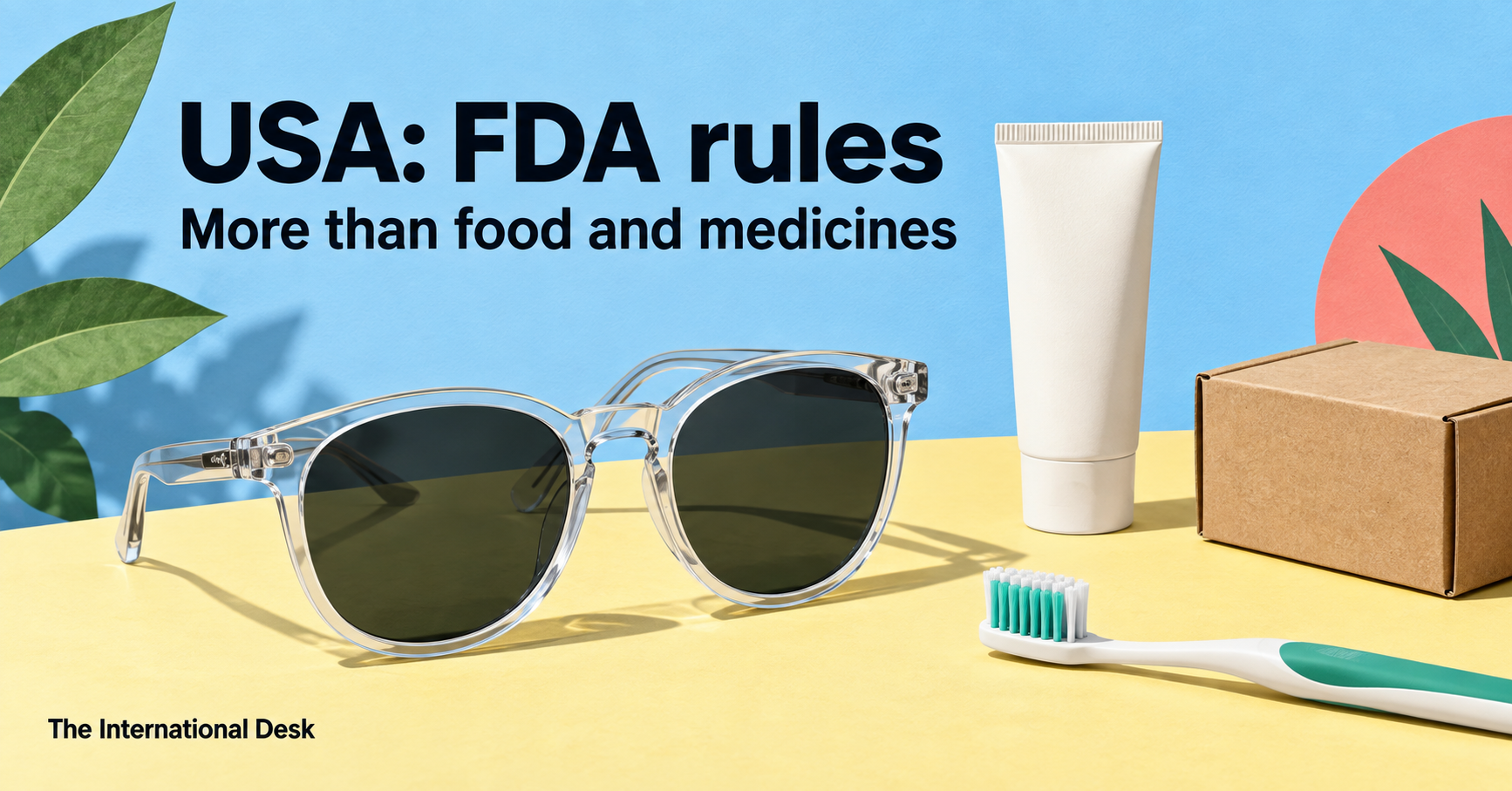
What products might surprise you?
FDA requirements reach beyond the products you would find in a pharmacy.
- Sunglasses, spectacle frames and reading glasses: regulated as medical devices.
- Manual toothbrushes: another everyday product classified as a medical device. FDA medical-device guidance ↗
- Makeup, moisturisers and perfumes: generally regulated as cosmetics.
- Sunscreens: regulated as drugs in the US.
- Anti-dandruff shampoos, antiperspirant-deodorants and moisturisers with SPF claims: can be both cosmetics and drugs, so both sets of requirements apply. FDA explanation of personal-care products ↗
The product’s ingredients, intended use and claims matter—not just the category you put it under on your website.
For example, a massage oil marketed simply to lubricate and fragrance the skin is different from one promoted as relieving muscle pain. Therapeutic claims can bring a product within US drug requirements. FDA guidance on cosmetics and drugs ↗
Sunglasses: a useful example
Ordinary non-prescription sunglasses are generally exempt from the FDA’s 510(k) premarket notification process—one of its procedures for reviewing devices before they are marketed.
However, being exempt from that particular review does not mean being exempt from FDA rules.
Relevant checks include:
- The manufacturer’s establishment registration and device listing.
- The UK seller’s registration and listing duties if it acts as a foreign device exporter.
- A designated US agent for the foreign manufacturer.
- Registration of the initial US importer, where applicable.
- Compliant labelling and applicable manufacturing requirements.
- Evidence that the lenses meet US impact-resistance requirements.
FDA guidance says an impact-resistance certificate should accompany each lot of sunglasses or spectacle lenses entering the US.
A supplier saying “they have UV protection” does not, by itself, demonstrate that these requirements have been met. FDA sunglasses requirements ↗
What if you only resell the sunglasses? FDA lists foreign device exporters as businesses that must register and list. A UK retailer exporting sunglasses to US customers cannot assume the manufacturer’s registration covers its own exporter role. The initial US importer has separate responsibilities; confirm who performs that role in your arrangement. FDA registration requirements by business activity ↗
Is getting an FDA number enough?
No. Registration is not the same as product approval.
For medical devices, FDA explicitly states that establishment registration and device listing do not mean it has approved, cleared or authorised the establishment or its products.
FDA also does not issue medical-device registration certificates. A document supplied by a commercial registration service should not be mistaken for FDA approval. FDA explanation of registration and approval ↗
When a supplier gives you an “FDA number”, ask:
- What exactly does this number identify?
- Which business, facility or product does it relate to?
- Is the registration or listing current?
- Does it cover the exact product being shipped?
- What other requirements still apply?
The answer will differ between medical devices, foods, cosmetics and drugs.
Who is responsible: the manufacturer, seller or importer?
It is not an either-or choice. Several businesses can have different responsibilities for the same product. These examples explain the distinction; they are not confirmation that a particular product or shipment complies.
Example 1: a UK shop sells sealed chocolate bars to a US household
The shop buys finished chocolate bars from a manufacturer and resells them without changing the packaging. Neither business needs a general “FDA approval” simply to sell ordinary chocolate. The questions are about registration, product compliance and the import process. FDA does not pre-approve individual food importers, products, labels or shipments. FDA food-import guidance ↗
- The manufacturer: its production facility generally needs food-facility registration unless exempt.
- The UK shop: may qualify for the retail food establishment exemption. The annual value of food sales directly to consumers must exceed food sales to all other buyers. Online sales can count if the criteria are met. This looks at the establishment’s overall food sales—not only US orders.
- The warehouse: a separate distribution or storage facility that does not itself sell directly to consumers generally needs its own registration. The shop’s exemption does not automatically cover it.
Foreign food facilities that must register also need a designated US agent. FDA food-facility registration and retail exemptions (PDF) ↗
The chocolate must meet US food-safety and labelling requirements. A familiar brand or a product legally sold in Britain is not, by itself, evidence that this particular product and packaging comply with US rules.
The parcel still needs Prior Notice—advance information sent to FDA about the food shipment. This applies to a retailer’s chocolate order sent by post or courier, including small orders for personal consumption. The seller can arrange submission with a broker or another person who has the required information. Manufacturer information must identify the actual manufacturer, not merely the shop selling the bars.
For food sent by international mail, Prior Notice must be submitted and confirmed before dispatch, with the confirmation number on the accompanying customs declaration. FDA Prior Notice guidance (PDF) ↗
Example 2: the same chocolate is sent to a US shop for resale
This brings in a separate question: who handles the Foreign Supplier Verification Program, or FSVP? This is the US importer’s food-safety verification responsibility, not a general approval number for the UK seller.
The FSVP importer is normally the US owner or purchaser at entry. If there is no US owner or consignee, a US agent or representative of the foreign owner or consignee must agree in a signed statement to take that role, unless an exemption applies. A customs broker or the food facility’s registration agent does not automatically become the FSVP importer.
Small quantities imported by a customer for personal consumption, without resale or public distribution, can be exempt from FSVP. Stock imported for resale does not qualify for that exemption. An FSVP exemption does not remove the separate Prior Notice requirement. FDA FSVP responsibilities and personal-consumption exemption (PDF) ↗
Supplying one US shop does not automatically remove the UK seller’s retail food establishment exemption: the registration test still looks at its overall annual food-sales mix.
Example 3: a UK business sells own-label moisturiser
For an ordinary cosmetic moisturiser without drug claims, the business making the product and the business named on its label can have different obligations under the Modernization of Cosmetics Regulation Act, or MoCRA.
- The manufacturing or processing facility: must register where the MoCRA requirement applies.
- The “responsible person”: the manufacturer, packer or distributor whose name appears on the product label must list the product where required. A UK seller using its own business name on the label may therefore have listing responsibilities even when another company makes it.
Reselling someone else’s unchanged product does not automatically make the retailer its responsible person. Certain small businesses are exempt from registration and listing, but eligibility depends on the business and product. These are not blanket exemptions from cosmetics law, and registration or listing is not FDA approval. FDA MoCRA roles, registration and exemptions ↗
If that moisturiser has SPF or treatment claims, check the US drug requirements too; the ordinary-cosmetics example is no longer the whole answer.
Does the carrier need to be FDA approved?
For ordinary retail parcels, “FDA-approved carrier” is not a general import requirement.
The useful distinction is between:
- The product meeting the applicable FDA requirements.
- Businesses or facilities holding any registrations required for their activities.
- The carrier accepting the product on the chosen service.
- The importer or customs broker submitting the correct entry information.
Customs brokers are licensed by US Customs and Border Protection, not given a general FDA approval. FDA’s entry guidance explains how brokers and importers provide information for FDA review. FDA entry-submission guidance ↗
Some logistics facilities can have their own FDA obligations—for example, certain food-storage facilities. That is different from approval of a delivery company. FDA food-facility registration guidance (PDF) ↗
My practical advice is to ask your carrier or broker:
“Do you accept this exact product on this service, and what information and arrangements do you need to clear it through US Customs and FDA?”
Do not assume that being able to purchase a shipping label answers those questions.
What information should you have ready?
Depending on the product, your carrier or broker may need:
- A precise product description and intended use.
- Manufacturer details—not just your shop or brand name.
- The correct US customs classification.
- A separate FDA product code.
- Relevant registration, listing or authorisation references.
- Supporting labels, ingredient information, certificates or test evidence.
An FDA product code and a customs tariff code serve different purposes. One does not replace the other. FDA import information requirements ↗
See examples of accurate customs descriptions →
Before you offer US delivery
Choose one product and check its complete journey:
- Establish how the US regulates it.
- Obtain evidence from the manufacturer.
- Confirm the responsibilities of the seller, manufacturer and US importer.
- Check acceptance and clearance arrangements with your carrier or broker.
- Make sure the required information reaches the person making the declaration.
If essential evidence is missing, resolve that before dispatch. FDA can detain or refuse products that do not meet the applicable requirements. FDA import checks ↗
Return to US product restrictions and safety → · Use the pre-dispatch checklist →
This is general guidance, not a product-specific compliance assessment. Check official requirements and obtain specialist advice where needed.